



















Newer
Heat Sink Material Selection Guide for Electronic Thermal Management
In the world of high-performance electronics, heat is the ultimate adversary. Whether you are building a custom gaming PC or designing an industrial control system, you have likely encountered the term “heatsink.” But beyond being a piece of metal bolted onto a chip, what does a heatsink actually do to keep your devices running smoothly?
At its core, a heatsink is a passive heat exchanger that moves the heat generated by an electronic component into the air. By increasing the surface area available to dissipate this heat, it prevents components from overheating. If you are currently facing thermal challenges in your product design, exploring professional thermal management solutions is often the first step toward building a more stable system.
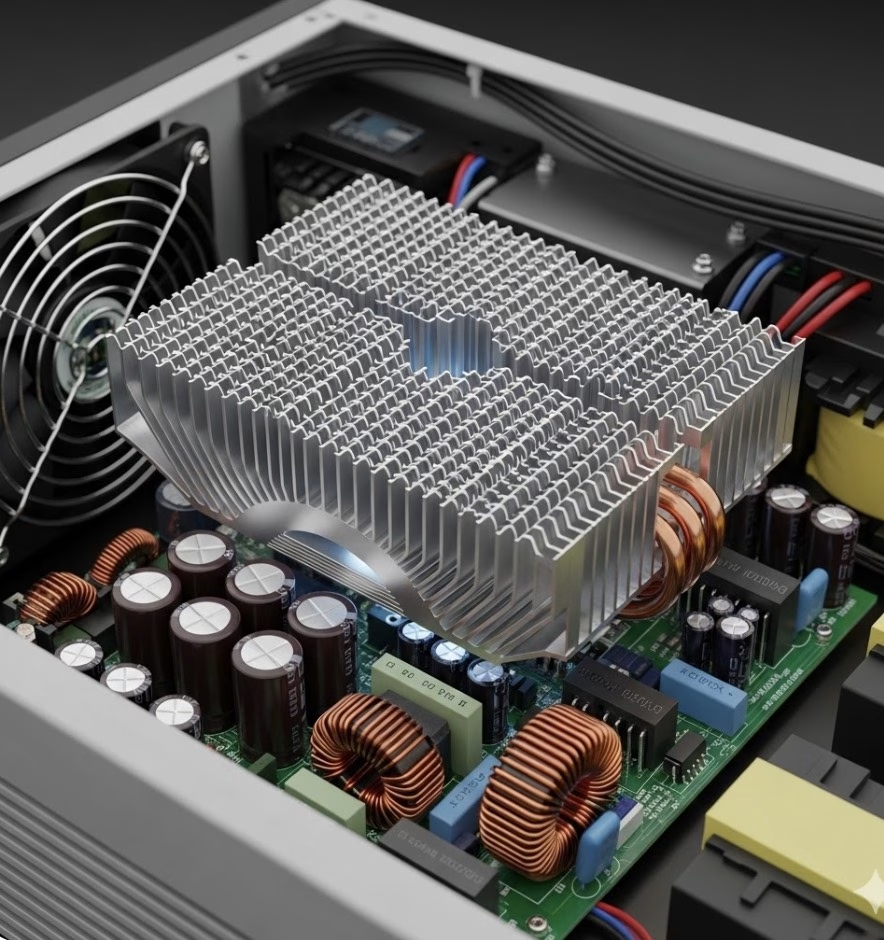
To understand how a heatsink functions, we have to look at the three fundamental ways heat moves: conduction, convection, and radiation. A well-designed heatsink leverages all three, though it relies most heavily on the first two.
Conduction is the direct transfer of heat through a solid material. When your CPU or power transistor works, it creates concentrated thermal energy. A heatsink sits directly on top of this component, acting as a bridge to pull that heat away from the silicon. Because the base of the heatsink is the most critical point of contact, selecting the right material and ensuring a flat surface is essential for efficient heat transfer.
Once the heat is conducted into the main body of the heatsink, it needs to be “shed.” This happens through convection. As air flows over the fins of the heatsink, it picks up the heat and carries it away. This is where geometry comes into play. By adding dozens of thin fins, we can exponentially increase the surface area exposed to the air without making the heatsink bulky. The more surface area available, the more air can circulate, which significantly boosts cooling efficiency.
While often overlooked, radiation also plays a minor role. Every warm surface emits infrared radiation. By using specific coatings or finishes, engineers can improve a heatsink’s ability to radiate heat directly into the surrounding environment. It’s a subtle boost, but in high-density electronics, every bit of efficiency helps.
If you look at modern thermal solutions, you will almost exclusively see copper and aluminum. Each has its own strengths depending on the specific application.
At Enner Group, we often combine these two materials. By using a copper base to handle the initial heat spike and bonding it to an aluminum fin array, we create a hybrid solution that offers the best of both worlds—fast heat absorption and efficient air-based dissipation.
A heatsink isn’t just about overclocking your processor; it is about system reliability. In industrial electronics, a single overheating transistor can cause an entire production line to shut down.
In a standard PC, your CPU produces immense heat in a very small area. The heatsink acts as a thermal buffer, ensuring that the processor stays under its thermal throttle point so you don’t lose performance during heavy tasks. In industrial settings, the stakes are even higher. Components like motor drives, power inverters, and LED arrays require robust, custom-engineered heatsinks that can withstand harsh environments, vibrations, and constant operation without failing.
This is where custom thermal design becomes essential. Off-the-shelf parts work for consumer PCs, but when you are dealing with unique form factors or extreme power densities, you need a solution tailored to your specific thermal load. Enner Group specializes in designing and manufacturing custom thermal modules that integrate seamlessly into complex hardware, ensuring your equipment stays cool no matter how hard it works.
Achieving optimal cooling isn’t just about picking the biggest heatsink. It is about how the heatsink interacts with its environment. If a heatsink is placed in a cramped case with no airflow, it will simply become a “heat trap.”
Engineers prioritize a “path of least resistance” for airflow. Whether using passive cooling—relying on natural rising hot air—or active cooling—using a fan to force air through the fins—the orientation and spacing of the fins are vital. If the fins are too close together, air can’t pass through easily. If they are too far apart, you lose the surface area needed for cooling. Finding that balance is the true art of thermal engineering.
Does a heatsink need thermal paste to work properly? Yes, thermal paste is necessary because it fills the microscopic gaps between the chip surface and the heatsink base to ensure efficient heat transfer. Without it, tiny air pockets act as insulators and trap heat against the chip.
Is a thicker, heavier heatsink always better? Not necessarily, because cooling efficiency depends more on fin surface area and airflow design than on the total mass of the metal. A lighter, well-designed heatsink with optimized fin spacing will often outperform a solid, bulky block of metal.
How do I know if my industrial equipment needs a custom heatsink? You should consider a custom solution if you notice consistent thermal throttling, frequent component failure, or if your operating environment limits the physical space available for standard cooling modules.
Can dust affect the performance of my heatsink? Absolutely; dust acts as an insulating layer that prevents heat from transferring to the air and clogs the airflow channels between the fins, leading to a sharp drop in cooling performance.
At the end of the day, a heatsink is far more than just a piece of metal. It is a critical component that guards the heart of your electronics against the damaging effects of heat. Whether you are aiming for peak PC performance or trying to ensure the longevity of industrial hardware, effective thermal management is non-negotiable. If you are struggling with thermal limitations or need a design that fits a specific power requirement, reach out to the team at Enner Group. We are here to help you design and build the cooling solution that keeps your systems running at their absolute best.