



















Newer
What Does a Heatsink Do? Understanding Thermal Management for Electronics
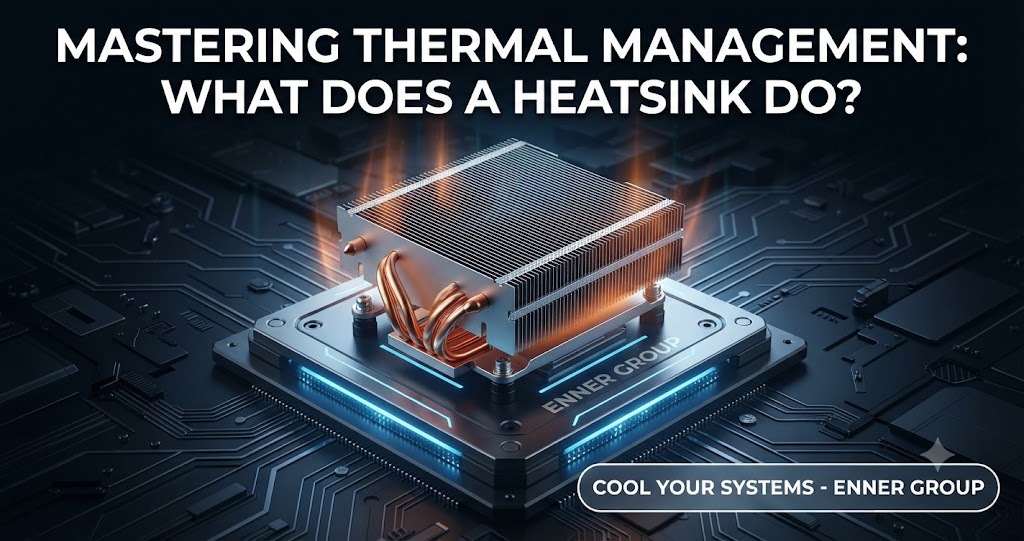
At its core, a heat sink absorbs and dissipates thermal energy away from high-temperature components. Heat sinks prevent sensitive hardware from overheating by transferring thermal energy into surrounding air or liquid.
Without effective cooling, high-power electronics face permanent failure.
A heat sink is a passive heat exchanger. It continuously transfers thermal energy from an electronic device into a cooling fluid. You can find these components almost everywhere today. They operate quietly inside laptops, medical devices, and heavy industrial machinery.
Microchips continue to shrink while packing far more processing power. This rapid increase in thermal density makes thermal management a critical engineering requirement rather than a secondary design choice.
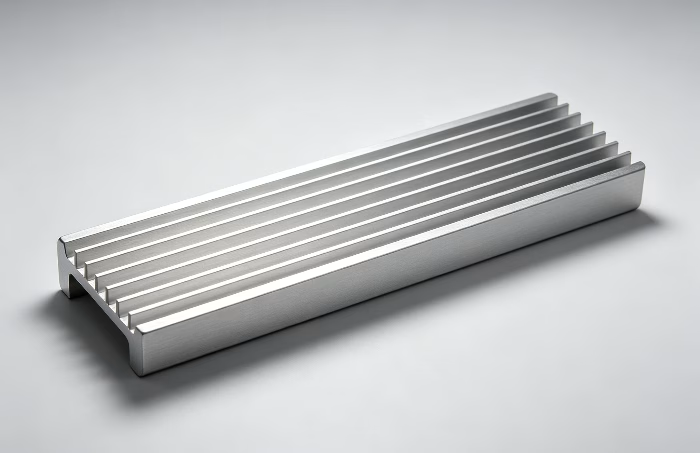
Heat sinks do more than just lower temperatures. They protect modern electronics across four essential functions:
Heat dissipation relies on four core physical steps working in sequence:
Thermal Conduction: Heat moves directly from the operating component into the solid metal base of the heat sink through direct contact.
Bridging Microscopic Gaps: No metal surface is completely smooth. Microscopic air pockets between the chip and base plate act as thermal insulators. Thermal Interface Materials (TIM)—such as pastes, pads, or gap fillers—seal these voids to lower thermal contact resistance.
Surface Area Expansion: Once heat reaches the base block, it spreads out across dozens of thin metal fins. This extended structural surface area gives the heat far more exposure to the surrounding environment.
Convection & Radiation: Finally, fluid motion sweeps heat away from the fin surfaces. This occurs either naturally as hot air rises or through forced convection driven by cooling fans.
Engineers optimize heat sinks by carefully selecting structural elements and metals.
Several specialized structures make up a modern cooling module:
For custom heat sink fabrication and optimized thermal architectures, explore Enner Group Thermal Solutions to match your exact power density specifications.
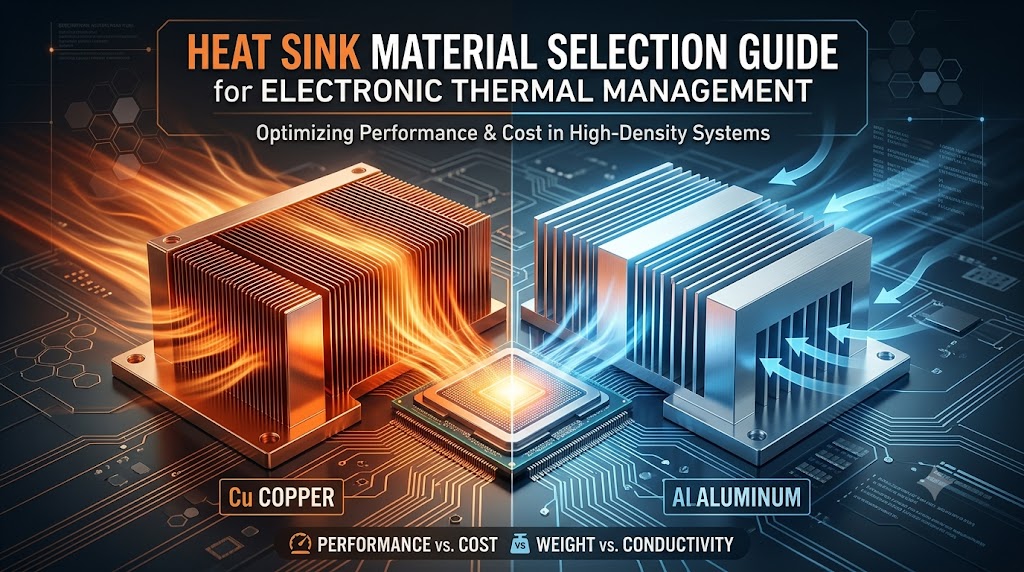
Selecting the right metal requires balancing weight, performance, and budget constraints.
| Metric | Aluminum Alloys | Copper |
| Thermal Conductivity | ~160–220 W/m·K | ~390–400 W/m·K |
| Density (Weight) | Lightweight (~2.7 g/cm³) | Heavy (~8.9 g/cm³) |
| Machinability & Cost | Lower material & fabrication cost | Higher material cost; harder to machine |
| Typical Use Case | Large surface areas, weight-sensitive designs | High-power-density zones, compact layouts |
To balance cost and weight with thermal performance, many modern systems utilize hybrid designs. These feature a heavy copper base block for rapid local heat extraction paired with lightweight aluminum fins for external air dissipation.
Different thermal environments demand different cooling methods.
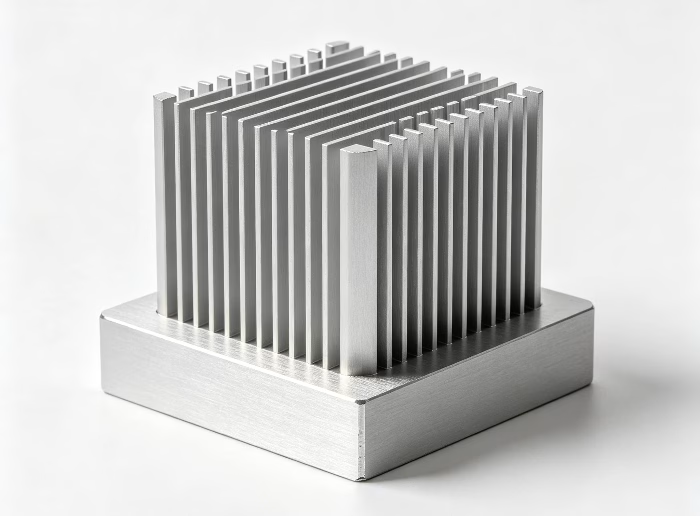
Thermal management underpins modern hardware performance across diverse fields:
Designing an optimal thermal solution requires balancing several interrelated physical metrics:
Passive heat sinks dissipate heat naturally without moving parts, while active heat sinks use fans or pumps to force airflow and liquid cooling. This allows active systems to handle much higher heat loads in smaller spaces.
TIM fills microscopic air gaps between the component and the heat sink base plate. Replacing these insulating air pockets with thermal conductive material drastically reduces thermal contact resistance.
Copper is chosen for high-heat, space-constrained zones due to its superior thermal conductivity (~390 W/m·K). However, aluminum is preferred when minimizing weight, material cost, and overall fabrication expense is critical.
Lower thermal resistance means the heat sink transfers thermal energy more efficiently, resulting in a smaller temperature rise per watt. Engineers select heat sinks with low enough resistance to keep silicon junction temperatures within safe limits.
Denser fins provide more surface area for cooling, but they also block incoming airflow by increasing static pressure. If fins are packed too tightly for the fan to push air through, cooling performance drops.
Managing complex thermal resistance calculations and custom fin geometries requires precision engineering. Whether you are building a high-power industrial module or optimizing an existing enclosure, our team provides tailored thermal assessments and precision fabrication.
To submit your design specifications or consult directly with our technical team, visit Enner Group Contact Us or reach out via email at [email protected].