Electronic components are shrinking while heat flux rapidly increases, leaving thermal engineers and procurement managers to balance cooling performance against manufacturing cost. While thermal throttling and hardware failures threaten high-power electronics, the extruded heat sink remains the most cost effective solution for scalable heat dissipation.
However, achieving optimal cooling requires more than selecting a catalog profile it demands a firm grip on alloy properties, die geometry limits, and secondary machining. This guide covers how extruded cooling works, essential Design for Manufacturability (DFM) rules to prevent die damage, and key strategies for sourcing high-volume thermal assemblies.
What Is an Extrusion Heat Sink and How Does It Work?
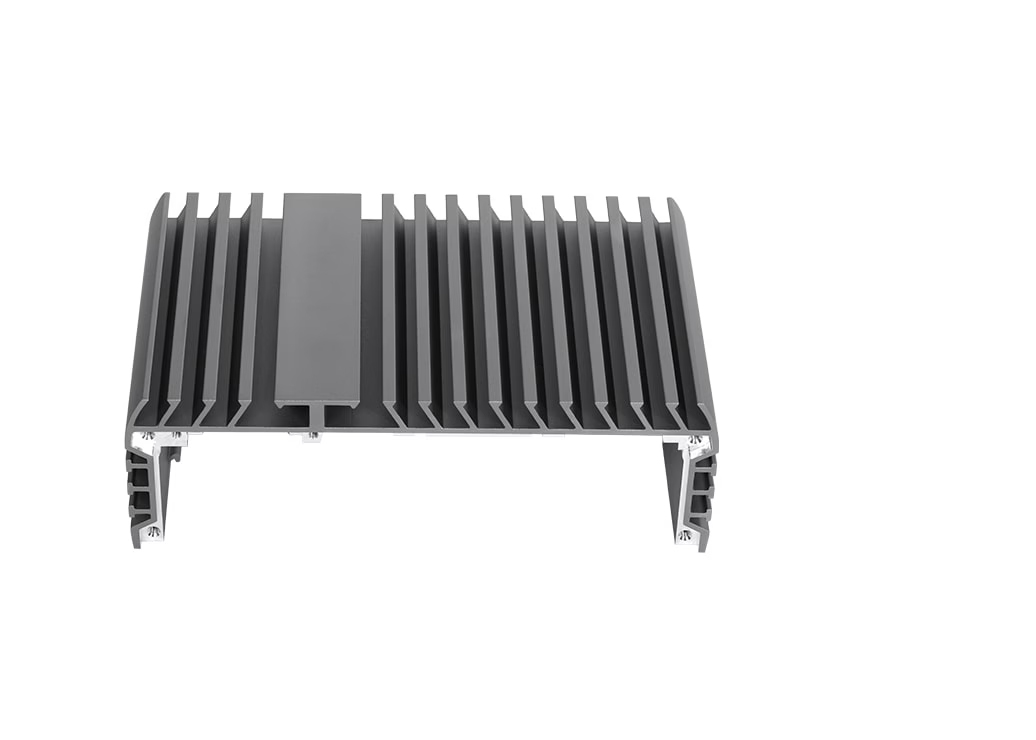
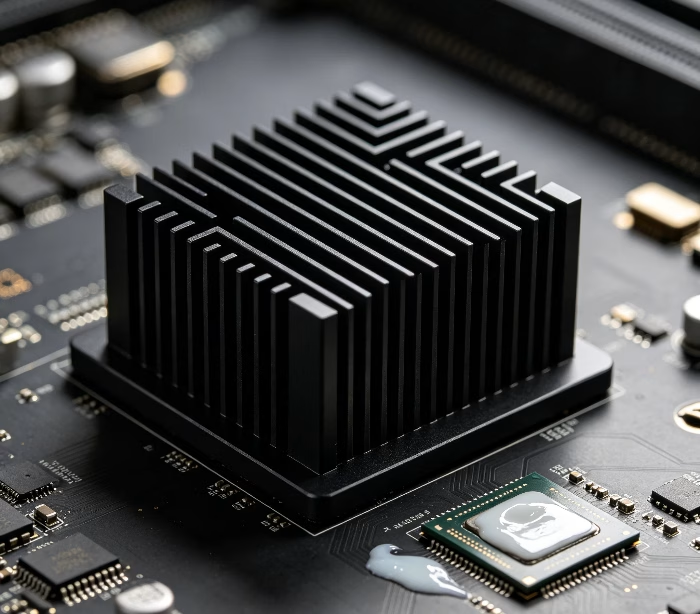
An extruded heat sink is a passive thermal management device engineered by forcing heated aluminum billets through a precision steel die. The die forms a continuous profile featuring a solid base plate integrated with thin, high-density fins.
Once cut to length and post-machined, the heat sink operates through a 3 step thermal dissipation cycle:
- Conduction: Heat generated by semiconductors transfers directly into the flat aluminum base plate upon mounting.
- Spreading: Thermal energy travels rapidly across the solid base and moves up into the extended fin array.
- Convection: Heat dissipates into the surrounding environment as air flows across the large fin surface area via natural draft or forced fan air.
Why Choose Extruded Heat Sinks Over Alternative Cooling Methods?
Selecting the wrong fabrication method early in NPI (New Product Introduction) can lead to blown unit costs or unexpected thermal bottlenecks during mass production.
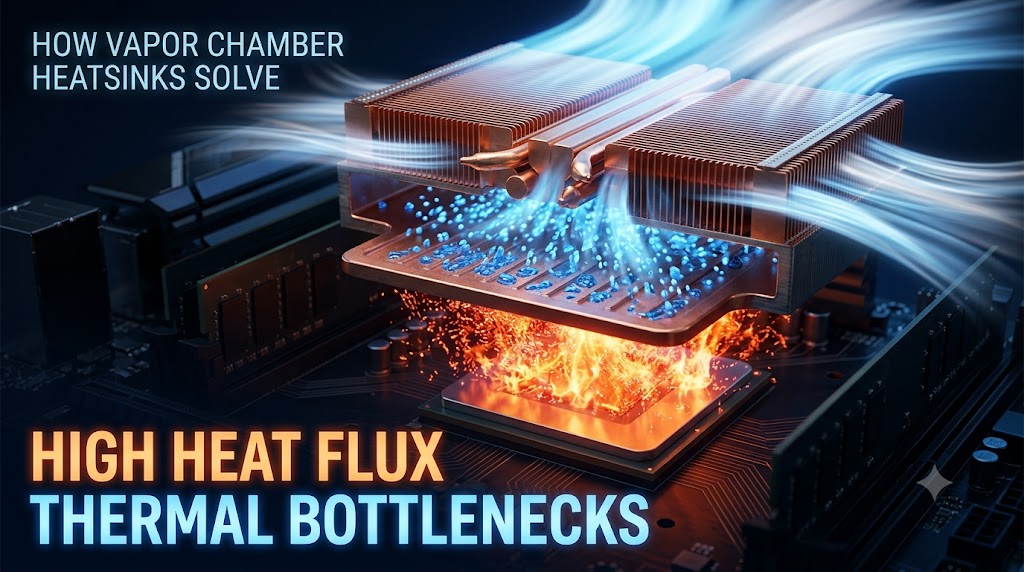
While ultra-high flux applications require phase-change devices like vapor chamber heatsinks or ultra-dense skived fin heat sinks, standard aluminum extrusions remain the sweet spot for high-volume electronics due to three core advantages:
- Unbeatably Low Cost-to-Performance Ratio: Aluminum billets and high-speed extrusion yield the lowest per-unit cost for medium-to-high volume runs.
- Secondary Machining Flexibility: Raw profiles can be easily post-processed using 3-axis/5-axis CNC machined parts methods to add mounting pockets, step-cut bases, and complex tapped holes.
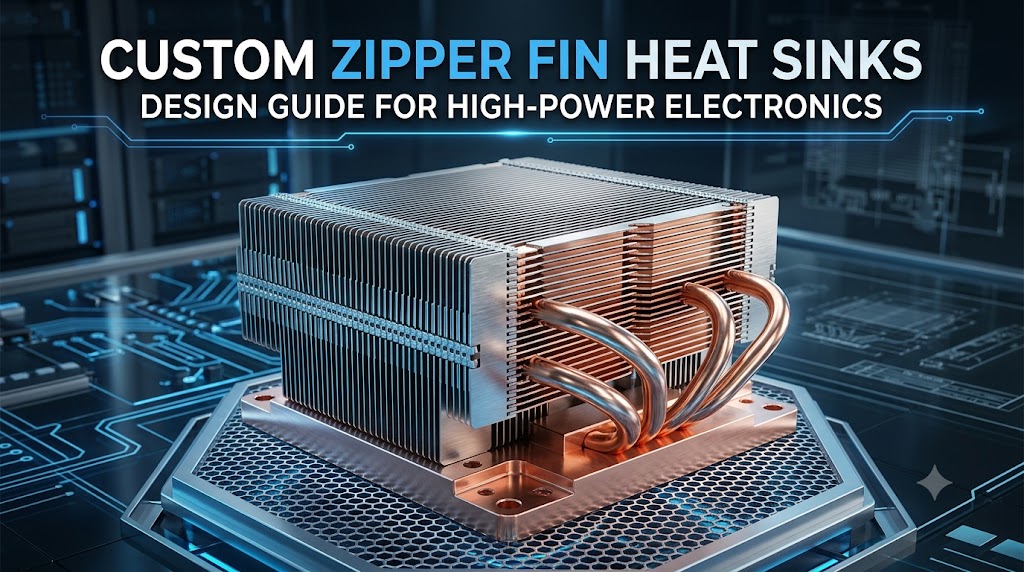
- Hybrid Assembly Compatibility: Extruded bases integrate seamlessly with high-density zipper fin heat sinks or stamped metal parts for customized enclosure mounting.
| Fabrication Process |
Tooling & Unit Cost |
Design Flexibility |
Thermal Resistance |
Target Application Range |
| Extruded Heat Sinks |
Low to Moderate |
High (Custom Lengths) |
Moderate |
Power Supplies, Drive Units, LEDs |
| Die Casting |
High Tooling Cost |
High (3D Geometries) |
Moderate to High |
Enclosures, Automotive Housings |
| Skived Fin |
Low Tooling Cost |
Medium (Thin Fins) |
Low |
High Density Servers, Computing |
| Zipper Fin |
Moderate |
High (Fin Stacks) |
Low |
Telecom Modules, Notebooks |
How to Select the Right Aluminum Alloy for Your Extrusion Heat Sink
Before drawing complex fin profiles, your material selection directly sets the baseline for thermal conductivity and structural rigidity. Different aluminum alloys offer distinct trade-offs between thermal performance, mechanical strength, and machinability down the line.
6063 vs 6061 Aluminum Alloys
- 6063 Aluminum Alloy: This is by far the most popular choice for thermal extrusions. It offers an impressive thermal conductivity around 200 W/m K, flows smoothly through intricate dies, and leaves a clean, smooth surface finish right out of the press.
- 6061 Aluminum Alloy: While its thermal conductivity is lower at around 166 W/m K, 6061 brings much higher tensile strength and structural rigidity. Reach for 6061 when your heat sink needs to double as a load bearing structural frame.
Temper Designations (T5 vs T6)
- T5 Temper: Air cooled straight out of the extrusion press and then artificially aged. T5 keeps internal stress low and maintains reliable dimensional stability.
- T6 Temper: Solution heat treated and artificially aged for maximum hardness. Choose T6 if your design requires heavy tapping or high torque threaded connections.
How to Avoid Costly Die Failures: Key DFM Rules First
In real world thermal engineering, DFM must always take precedence over pure performance optimization. Designing theoretically ideal fins means nothing if the geometry cannot survive the extrusion press. Skimping on basic tool manufacturability is the fastest way to break extrusion dies, wreck your budget, and delay project delivery.
- Fin Aspect Ratio Limits: Aspect ratio represents fin height divided by the gap between fins. Keep this ratio under 8:1 for standard production runs. Pushing past 10:1 places extreme pressure on the internal steel fingers of the die, which can easily cause tool teeth to break under press tonnage.
- Minimum Root Thickness (The Hidden Pitfall): Beyond aspect ratios, pay close attention to the root wall thickness between adjacent fin bases. If the metal thickness at the root drops below 0.8 mm to 1.0 mm, the steel die tongue lacks structural support and will tip or deform under high press forces, leading to ruined profiles.
- Add Radii at Fin Roots: Sharp 90 degree corners where fins meet the base cause severe stress buildup in both the die and the extruded part. Adding a simple 0.5 mm to 1.0 mm fillet radius helps soft aluminum flow smoothly through the die, reduces thermal resistance at the fin base, and dramatically extends tool life.
- Plan for Flatness and Bowing: Long aluminum extrusions tend to twist or bow slightly as they cool down on the runout table. For high power applications where direct contact is everything, specify post process face milling to hold base flatness within 0.05 mm.
What Key Parameters Impact Extrusion Heat Sink Performance?
With a manufacturable geometry locked in place, you can safely fine tune your dimensions for maximum heat removal. Good thermal design is all about striking a balance: you want lower thermal resistance without choking airflow or adding wasted aluminum.
- Base Plate Thickness Rule of Thumb: Make the base too thin and heat cannot spread laterally, creating severe hot spots right above your semiconductors. As a practical engineering rule of thumb, target a base thickness equal to 1/3 to 1/2 of your primary heat source width. Making the base excessively thick beyond this range adds thermal mass and raw material cost without offering meaningful thermal resistance gains.
- Fin Height and Fin Pitch Boundaries: Taller fins add surface area, but placing them too close together creates excessive pressure drop. For natural convection setups, keep fin pitch at or above 6.0 mm so buoyant air currents can move freely. For forced air cooling with fans, narrow the pitch down to 3.0 mm – 5.0 mm to balance surface area against fan static pressure.
- Surface Coatings for Radiation: Bare aluminum does not radiate heat effectively on its own. Adding a black anodized finish raises surface emissivity from roughly 0.05 up to 0.85 – 0.90, delivering a 10 to 15 percent boost in overall thermal dissipation for natural convection systems.
Why Partner with Ennergroup for Custom Thermal Management?
Taking a thermal concept from initial prototype all the way to mass production takes more than just a standard machine shop. You need an experienced thermal manufacturing partner who understands tooling tolerances, simulation, and quality control inside out.
That is where Ennergroup comes in. We bring deep engineering capacity and real world manufacturing controls to your supply chain:
- In House R&D Engineering Team: Powered by a cohesive team of 500 employees, our engineering department brings together university graduates in thermodynamics, mold design, and materials science.
- Thermal Simulation and Fast Prototyping: Using full suite thermal simulation software, Ennergroup models airflow, pressure drop, and heat distribution before cutting any steel, ensuring rapid sample turnaround and real world accuracy.
- Certified Manufacturing Operations: Ennergroup operates under strict quality management systems certified to ISO9001, ISO14001, and IATF16949 standards, supported by 19 practical utility patents.
- Trusted by Global Industry Leaders: From initial custom design to final procurement and delivery, Ennergroup delivers reliable thermal solutions to global brands like AVC, Flextronics, Siemens, and Nokia.
Frequently Asked Questions (FAQ)
What is the typical lead time for custom extrusion heat sink tooling?
Building a new custom aluminum extrusion die generally takes 2 to 3 weeks. Once the die passes first article inspection, prototype samples and CNC post processing can be completed in just 5 to 7 business days.
What is the maximum fin aspect ratio achievable in aluminum extrusion?
We recommend keeping fin aspect ratios under 8:1 for reliable, cost effective mass production. Specialized dies can push up to 10:1, but higher fin densities usually call for skived fin manufacturing instead.
Does black anodizing improve heat sink cooling performance?
It certainly does for passive designs. Black anodizing raises the surface emissivity of bare aluminum from around 0.05 to over 0.85, giving you a 10 to 15 percent boost in natural convection cooling.
Can extruded heat sinks be combined with heat pipes or vapor chambers?
Yes. We routinely mill precision channels into extruded bases to embed heat pipes or mount vapor chambers. This hybrid setup moves concentrated heat off high flux chips quickly and spreads it across the larger extruded fin surface.
Conclusion
Aluminum extrusion heat sinks continue to offer an unbeatable mix of mechanical strength, design versatility, and affordability for modern electronics. By selecting the proper 6063 alloy, prioritizing DFM guidelines early, and choosing the right surface treatment, you can tackle tough thermal problems without burning through your project budget.
If you are currently working on a high power project squeezed by tight enclosure limits, send your 3D CAD models or thermal dissipations directly to the engineering team at Ennergroup. We will provide a preliminary CFD thermal simulation report and a detailed DFM tooling evaluation within 24 hours . Contact us today to start optimizing your cooling architecture.