



















Newer
What Is a CPU Heat Sink and How Does It Keep Your Computer Cool?
As server performance continues to rise and data center equipment becomes more compact, thermal design has become a critical part of system development. For server manufacturers, telecom equipment brands, and infrastructure integrators, effective thermal management solutions for server and data center equipment are no longer optional. They directly influence system reliability, operating efficiency, hardware lifespan, and even long-term maintenance costs.
Today’s servers operate under heavy and continuous workloads. CPUs, GPUs, memory modules, power supplies, network switches, and storage systems all generate large amounts of heat in a limited space. If this heat cannot be transferred and dissipated efficiently, the result may be performance throttling, unstable operation, increased power consumption, or premature component failure. In high-density data centers and mission-critical environments, poor cooling design can also affect uptime and service continuity.
That is why more OEMs and project teams are looking beyond standard cooling parts and turning to custom thermal management solutions. A well-designed cooling system does more than reduce temperature. It helps improve airflow efficiency, manage hotspots, support compact layouts, and maintain consistent product performance over time.
For companies developing server hardware and data center equipment, thermal design should be approached as part of the overall engineering strategy, not as a last-minute adjustment.
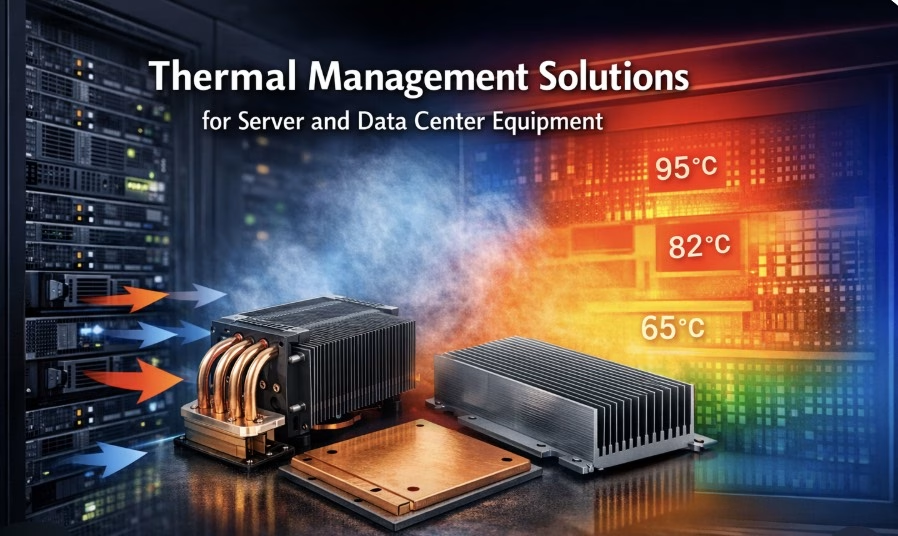
The thermal challenges in server and data center applications are very different from those in low-power electronics. These systems often run 24/7, operate in dense rack environments, and carry workloads that generate concentrated heat at key points. As chip power continues to increase, the cooling structure must handle higher heat flux while staying within strict mechanical limits.
When thermal management is insufficient, several problems can occur.
The first is performance reduction. Processors and power devices may automatically lower performance when temperatures rise beyond safe operating ranges. In applications such as AI servers, edge computing, cloud infrastructure, and storage systems, even small temperature increases can affect system throughput and responsiveness.
The second is reliability risk. High operating temperatures accelerate material aging and increase the chance of thermal stress-related failures. Solder joints, interfaces, insulation materials, and surrounding components can all be affected when heat is not properly controlled.
The third is higher operating cost. Inefficient thermal design often requires faster fan speed or additional cooling support, which raises energy consumption. Across large-scale deployments, this can significantly increase overall operating expense.
The fourth is limited design flexibility. Poor heat dissipation can restrict system layout, reduce component density, and make it harder to build compact, high-performance products.
For these reasons, thermal management plays a central role in the design of reliable server and data center equipment.
Different applications require different cooling approaches. The best solution depends on heat source type, thermal load, mechanical space, airflow path, and cost target. In most projects, engineers evaluate multiple technologies before selecting the right structure.
Extruded aluminum heat sinks are one of the most common cooling solutions for server and industrial electronics. They offer a practical balance between thermal performance, design flexibility, and production efficiency.
For applications with stable airflow and moderate-to-high heat loads, extruded heat sinks provide reliable cooling with good scalability for mass production. They are widely used in power modules, server subassemblies, and communication equipment where cost control and manufacturability are important.
Heat pipes are highly effective when heat must be transferred quickly away from a concentrated source. In servers and data center hardware, heat pipes are often used to move heat from processors, GPUs, or power devices to a remote fin area where airflow is stronger.
This approach is especially valuable in compact equipment where the hottest components are not positioned directly in the main airflow path. Heat pipe cooling helps improve heat spreading, reduce local hotspots, and support more efficient internal thermal layout.
Vapor chambers are often selected for applications with high power density and limited space. Compared with traditional solid-base structures, vapor chambers provide faster and more uniform heat spreading across a wider area.
In high-performance server systems, accelerator modules, and advanced communication equipment, vapor chamber solutions can improve thermal uniformity and enhance the overall effectiveness of the fin structure. They are particularly useful when hotspot control is a major design concern.
Skived heat sinks are suitable for applications that require high fin density and strong cooling performance within a compact footprint. Because the fins are formed directly from a solid metal block, skived designs offer low thermal resistance and strong structural integrity.
They are often used in server equipment, power electronics, and other thermal applications where space is limited but cooling demand is high.
Thermal design for server and data center equipment is not only about choosing a heat sink. Real-world applications involve multiple constraints that must be considered together.
One of the biggest challenges is high heat density. Modern processors and power components generate more heat in smaller packages, which makes hotspot management more difficult.
Another challenge is limited installation space. In compact server designs such as 1U or 2U systems, there may be very little room for large cooling structures. Engineers must optimize both thermal performance and mechanical compatibility.
Airflow conditions also vary widely from one platform to another. The same thermal component may perform very differently depending on fan layout, duct design, obstruction level, and rack environment.
In addition, teams must consider manufacturing feasibility. A cooling design may look effective in simulation, but it also needs to be practical for machining, assembly, testing, and large-scale production.
This is why thermal management for server and data center equipment usually requires a custom engineering approach rather than a simple off-the-shelf selection.
For buyers, engineers, and product teams, choosing a thermal solution should begin with application requirements rather than component catalogs. A reliable supplier will usually evaluate several key inputs before recommending a solution.
These include:
A proper thermal management partner should be able to support not only production, but also thermal simulation, structural optimization, prototype verification, and manufacturing planning. This is especially important in server and data center projects, where small thermal changes can have a major impact on overall system performance.
Many companies start with standard cooling components during early development. This can be useful for basic testing, but it often becomes limiting when the product moves toward optimization and scale production.
A custom thermal management solution can be designed around the real heat source, the actual chassis layout, and the target airflow conditions. This allows the cooling structure to fit the product more precisely and perform more efficiently.
The commercial value is also clear. Better cooling can improve product stability, reduce failure rates, support higher system performance, and lower maintenance risk. For brands selling servers, communication equipment, and data center hardware, this directly affects customer satisfaction and long-term competitiveness.
Instead of treating cooling as a simple component purchase, more companies now see it as part of product value engineering.
If your project involves server or data center equipment, the supplier should offer more than standard parts. You should look for a manufacturing partner with real development capability and practical project experience.
A strong supplier should be able to provide:
This type of supplier can help reduce development risk, shorten project timelines, and improve consistency between prototype and production.
For many OEM and ODM projects, this is more valuable than choosing the lowest-cost part alone.
If you want a faster and more accurate proposal, it helps to prepare basic project information before contacting a thermal management manufacturer.
Useful details include:
The more complete the information, the easier it is for the supplier to recommend a solution that matches your performance and manufacturing goals.
As data center infrastructure grows more compact and computing power continues to rise, thermal management solutions for server and data center equipment are becoming more important than ever. Effective cooling improves system reliability, protects performance, extends equipment lifespan, and helps reduce operating costs.
Whether your project requires extruded heat sinks, heat pipe assemblies, vapor chambers, or other custom cooling structures, the right solution should be based on actual application requirements rather than generic part selection. For server and data center hardware, thermal management is not just a design detail. It is a key part of product quality and market competitiveness.
If you are developing server hardware, communication systems, or data center equipment and need a more effective cooling solution, working with an experienced thermal management manufacturer can help you move from concept to production more efficiently.
Looking for custom thermal management solutions for server and data center equipment? Contact Enner to discuss your project requirements, request technical support, or get a fast quotation.
The best solution depends on heat load, space limitations, airflow conditions, and product design. Common options include extruded heat sinks, skived heat sinks, heat pipes, and vapor chambers.
Thermal management helps prevent overheating, improve performance stability, extend hardware lifespan, and reduce energy consumption in high-density operating environments.
A vapor chamber is often a better choice when the heat source is highly concentrated and uniform heat spreading is required in a limited space.
In many server and data center applications, custom solutions provide better fit, higher efficiency, improved hotspot control, and better long-term reliability.
You should share the application type, heat source details, power level, available space, airflow conditions, material preference, and expected production volume.