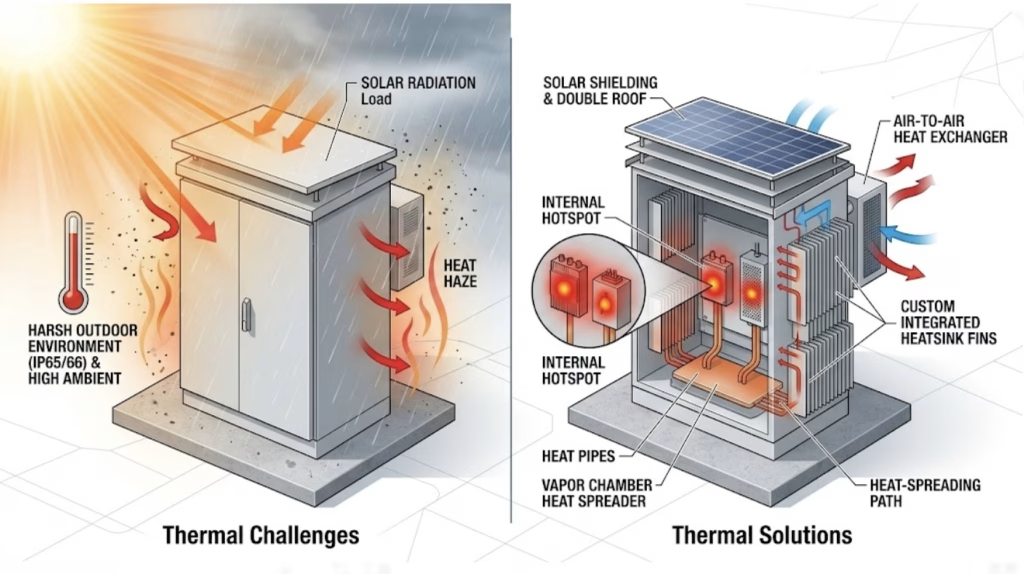
IGBT modules are widely used in industrial power electronics such as motor drives, UPS systems, welding equipment, renewable energy converters, and power conversion cabinets. In these applications, the module must switch high current and voltage reliably while operating under heavy thermal stress. That is why cooling is not just a supporting detail in IGBT design. It is one of the main factors that determines efficiency, reliability, service life, and power density. Manufacturer application manuals consistently emphasize that the thermal design must keep the module’s junction temperature below its specified maximum value, and that heat-sink selection should be based on the actual operating losses of the module.
Why IGBT Cooling Matters
When an IGBT module runs too hot, performance and reliability both suffer. Higher temperature increases thermal stress on the semiconductor chips, solder layers, substrates, interface materials, and surrounding components. In practice, overheating can shorten lifetime, reduce system stability, and increase the risk of failure in the field. This is why IGBT thermal design is usually built around the full thermal path from junction to case to heat sink and then to ambient, rather than around the heat sink alone. Fuji’s application manual explicitly defines these thermal resistance segments and shows that junction temperature depends on the complete thermal chain, not just one component.
Start with Power Loss and Junction Temperature
The first step in cooling an IGBT module is to calculate the module losses under real operating conditions. Only after that can you choose the right cooling structure. Fuji’s current application guidance states that engineers should first calculate IGBT loss, then select a heat sink that keeps the virtual junction temperature below the specified limit. If the thermal design is insufficient, the junction temperature may exceed the allowed maximum during operation and destroy the module.
For industrial power electronics, this is especially important because operating conditions often vary with switching frequency, load cycle, ambient temperature, and enclosure design. A module that looks acceptable in nominal conditions may run too hot during overload, peak duty, or poor ventilation. Good thermal design therefore starts with realistic load profiles rather than catalog assumptions.
Choose the Right Cooling Method
There is no single best way to cool all IGBT modules. The correct method depends on power level, package size, mounting space, airflow, reliability targets, and enclosure constraints.
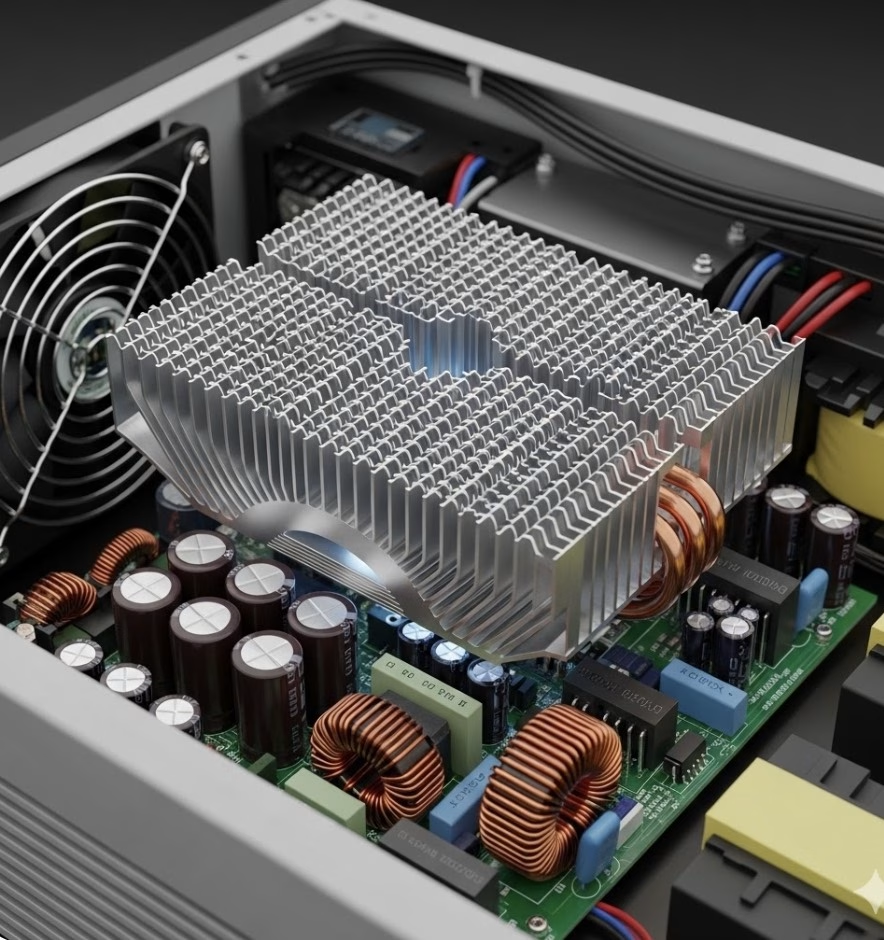
For many standard industrial systems, air-cooled heat sinks are still the most practical solution. Extruded aluminum heat sinks are widely used where cost control, scalable manufacturing, and steady airflow are available. Enner’s own heat-sink pages position extruded profiles as a good fit for reliable industrial thermal management, while skived heat sinks are presented as a better option where higher fin density and stronger cooling are needed in limited space.
For more demanding thermal loads, skived heat sinks, heat-pipe assemblies, or vapor-chamber-supported structures may be more effective. Enner describes skived heat sinks as suitable for compact, high-heat applications and highlights heat-pipe and vapor-chamber solutions for managing higher thermal density and improving heat spreading across the structure. For industrial converters and high-power drives, these options can help reduce hotspots and use limited space more efficiently.
When power density becomes very high, liquid cooling or water-cooled cold plates may be necessary. Fuji notes that IGBT modules in compact, high-density converter installations are often water-cooled to improve mounting density and reduce thermal resistance. Its automotive application material also states that direct water-cooling structures can suppress thermal resistance more effectively than the conventional air-cooled heat-sink approach.
Thermal Interface Material Is Critical
Even an excellent heat sink will underperform if the contact between the module base and the cooling surface is poor. That is why thermal interface material, or TIM, is one of the most important details in IGBT cooling.
Fuji’s application manual explains that thermal grease is used to reduce contact thermal resistance between the module and the heat sink, but it also warns that grease that is too thick can hinder heat dissipation, while grease that is too thin can leave air gaps and increase thermal resistance. The same manual recommends a uniform grease thickness of about 100 μm after spreading. Mitsubishi’s recent industrial LV100 note similarly recommends a uniform grease thickness of about 50 to 100 μm when grease is used between the module and the heat sink.
This is a major reason why many field thermal problems come from assembly quality rather than from the heat sink design itself. Uneven grease, inconsistent pressure, or poor mounting flatness can all raise interface resistance and push chip temperature higher than expected. Infineon and Mitsubishi both also document the growing use of pre-applied TIM or phase-change TIM options to improve consistency and long-term thermal performance.
Mounting Flatness and Torque Directly Affect Heat Transfer
In IGBT module cooling, mechanical assembly quality is part of thermal design. Fuji’s manual specifies that the heat-sink mounting surface should have controlled roughness and flatness, and notes that poor surface conditions can increase contact thermal resistance or even create mechanical stress issues. Mitsubishi also gives module-mounting guidance that stresses flatness and even TIM application on the contact surface.
This means that cooling an IGBT module is not only about selecting a bigger heat sink. The baseplate, clamping pressure, screw torque, surface finish, and mounting method all influence real thermal performance. In industrial production, these details should be standardized so that prototype performance can be repeated consistently in mass production.
Optimize Airflow, Not Just Heat Sink Size
In forced-air systems, airflow direction and flow rate are just as important as fin area. A heat sink that works well on paper may perform poorly if the airflow is blocked by busbars, capacitors, cable routing, or enclosure walls. For industrial drives and power cabinets, designers should look at the whole internal air path, not only the module footprint.
This is one reason custom thermal design often performs better than off-the-shelf cooling hardware. Enner’s industrial heat-sink content repeatedly emphasizes matching the structure to heat output, size, and airflow rather than choosing a generic profile. In practice, this means the best IGBT cooling solution is usually the one designed around the actual converter layout, fan direction, and thermal load distribution.
Watch for Special Conditions: Altitude and Condensation
Industrial power electronics are not always installed in ideal environments. Infineon’s application guidance points out that at elevated altitudes, the lower air pressure reduces the cooling capability of air-cooled systems, so the thermal design has to be re-evaluated. That matters for drives, renewable energy equipment, and industrial cabinets deployed in mountainous or high-altitude regions.
Water cooling also introduces its own design risks. Mitsubishi’s latest IGBT guidance notes that condensation measures are necessary in units using water cooling, because the module itself does not provide dew-condensation protection and sealing materials can have moisture permeability. In other words, liquid cooling can improve thermal performance, but it must be engineered carefully to avoid reliability problems caused by moisture.
Best Cooling Options for Different Industrial Scenarios
For medium-power industrial drives and general converters, a properly sized extruded or skived aluminum heat sink with controlled TIM thickness and good airflow is often enough. For compact, high-density inverters, skived heat sinks, copper-based solutions, or heat-pipe-assisted structures can improve local heat spreading. For very high-power converters, traction-like systems, or dense power cabinets, cold plates or water-cooled designs may be the more realistic solution. Fuji’s published materials show that higher-density applications increasingly move toward water-cooling to reduce thermal resistance and support compact packaging.
What to Send When Requesting an IGBT Cooling Solution
If a customer wants a practical custom solution faster, the inquiry should include more than the module part number. A thermal supplier will usually need:
- IGBT module model and quantity
- power loss or operating current/voltage data
- switching frequency and duty cycle
- allowable case or junction temperature target
- enclosure dimensions and airflow direction
- ambient temperature range and installation altitude
- preference for air cooling or liquid cooling
- drawings, mounting hole layout, and clearance limits
Providing this information early makes it much easier to select the right heat sink structure, TIM method, and manufacturing approach. That is especially important for companies like Enner that position themselves as custom thermal-solution manufacturers rather than just stock-part sellers.
Conclusion
Cooling IGBT modules in industrial power electronics is not just about attaching a heat sink. It requires a complete thermal strategy built around power loss, junction temperature limits, interface resistance, mounting quality, airflow, and the real operating environment. Manufacturer guidance is very clear on this point: loss calculation comes first, junction temperature must stay below the limit, TIM thickness must be controlled, and assembly quality directly affects the final thermal result.
For many industrial systems, custom cooling performs better than standard solutions because it can be tailored to the module layout, enclosure space, airflow path, and power density. Whether your project needs an extruded heat sink, a high-density skived design, a heat-pipe structure, or a water-cooled baseplate, the goal is the same: lower thermal resistance, more stable junction temperature, and longer system life. Enner’s product lineup and recent content align well with this kind of application-based thermal approach.
Looking for a custom cooling solution for IGBT modules in industrial power electronics? Contact us with your module model, thermal load, and layout drawings to get a faster recommendation and quotation.
FAQ
What is the most important factor in cooling an IGBT module?
The most important starting point is the module’s actual power loss and its maximum allowed junction temperature. The cooling structure should be selected only after confirming that the junction temperature will remain below the specified limit.
Is thermal grease always necessary for IGBT modules?
For many module-to-heat-sink assemblies, yes. Manufacturer guidance shows that thermal grease or another suitable TIM is used to reduce contact thermal resistance, but it must be applied uniformly and at the recommended thickness.
When should I use liquid cooling for IGBT modules?
Liquid cooling becomes more attractive when power density is high, space is limited, and air cooling cannot keep the module within its thermal limits. Fuji’s application materials specifically describe water cooling as a way to increase mounting density and lower thermal resistance.
Do mounting quality and flatness really affect IGBT temperature?
Yes. Official application manuals state that poor flatness, roughness, or incorrect assembly can increase contact thermal resistance and worsen thermal performance.
Can altitude affect IGBT cooling?
Yes. Infineon notes that at higher altitudes, lower air pressure reduces the effectiveness of air-cooling systems, so the thermal design must be checked again for those operating conditions.